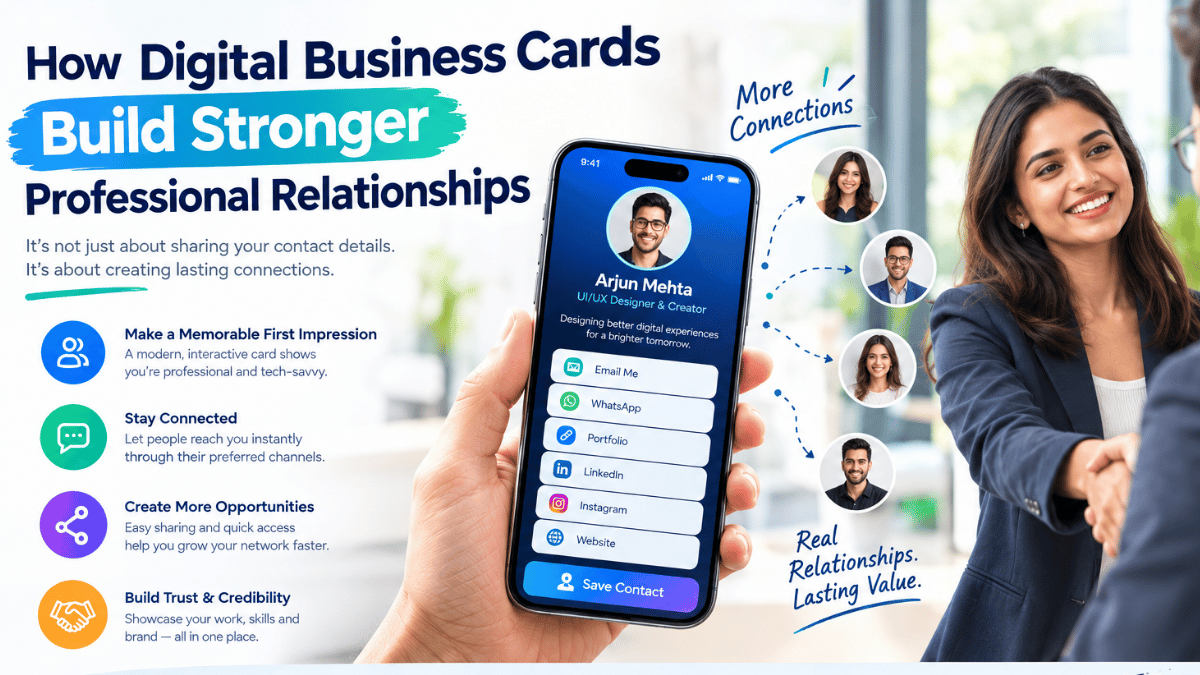

Business success has always been built on relationships. But in modern networking, the real challenge isn't exchanging contact details — it's creating a connection that lasts beyond the first handshake. Signify digital business cards close the gap between introduction and ongoing relationship by replacing static paper with a rich, trackable, always-current professional profile. This guide explains why relationships matter more than ever, where paper cards fall short, and how digital cards — shared via NFC tap, Smart QR code, or direct link — turn every introduction into a measurable step toward a stronger professional relationship.
The shift is already underway. Industry data shows that 88% of paper business cards are discarded within a week — meaning the vast majority of traditional networking effort produces no lasting connection at all. Meanwhile, teams using digital cards with built-in lead capture report 3X higher conversion from handshake to CRM contact compared to paper-based workflows. The difference isn't just convenience; it's relationship architecture.
Why relationship building matters in modern networking
Every opportunity begins with a connection. Whether you're closing a sales deal, building a strategic partnership, growing a startup, expanding your client base, attending industry conferences, or recruiting top talent — your ability to develop professional relationships directly impacts business growth.
Research consistently shows that people prefer doing business with professionals they know, trust, and remember. A digital business card supports this dynamic by making it easier for contacts to remember you, reach you, and engage with your work — without the friction that kills most paper-based follow-ups.
The most successful networking interactions share a common pattern: they make it easy for the other person to connect. When you remove barriers — manual data entry, lost cards, outdated contact details — you create more opportunities for the relationship to develop. That's the core mechanism behind why digital cards outperform paper for relationship-driven professionals.
The implication is clear: if most paper cards disappear before they become contacts, and digital cards convert at three times the rate, then the format you choose directly determines how many relationships you're able to build from the same networking effort.
The problem with traditional business cards
Traditional paper cards have remained unchanged for decades. Despite their familiarity, they introduce structural barriers to relationship building that no amount of good design can overcome.
Limited information
A paper card typically holds a name, job title, company, phone number, and email. Today's professionals have much more to share — portfolios, social profiles, booking links, product information, case studies, and more. A Signify online business card can carry all of these in a single shareable profile.
High follow-up friction
After receiving a paper card, the recipient must manually enter contact details, search for social profiles, and save information across multiple platforms. Each additional step reduces the likelihood of follow-through. Digital cards eliminate this friction entirely — the recipient saves your live profile with one tap, and it stays current forever.
Short lifespan
An estimated 88% of paper cards are thrown away within a week. The physical artifact disappears, and with it the opportunity for a follow-up conversation. A Signify electronic business card lives in the recipient's phone, accessible whenever they need it.
The bottom line: paper cards were designed for a world where contact information was static and follow-up was manual. Neither assumption holds today. Smart business cards replace both with a dynamic, frictionless alternative built for modern relationship building.
How digital cards strengthen professional connections
Digital business cards don't just digitize the paper card — they fundamentally change what a card exchange can accomplish. Here are the four mechanisms that matter most for relationship building.
Immediate value delivery
Recipients gain instant access to your contact info, social profiles, website, calendar, and more — without asking or searching.
Better first impressions
A digital card signals professionalism, modernity, and efficiency — qualities that shape how you're perceived from the first interaction.
Personal branding support
Your card acts as a centralized professional hub — presenting a consistent brand across every platform you choose to include.
Easier follow-ups
One-tap saving, direct messaging, instant calling, scheduling links, and social connections remove every barrier to staying in touch.
Each of these mechanisms compounds the others. A smoother first interaction makes a stronger first impression; a stronger impression makes the recipient more likely to save your contact; an easier save makes follow-up more likely; a successful follow-up turns a handshake into a relationship. The Signify solutions overview describes how these capabilities fit together across different professional use cases.
Building trust through digital engagement
Trust is one of the most valuable assets in business. People trust professionals who appear accessible, authentic, transparent, and credible. Digital business cards support trust-building in several concrete ways.
Professional profiles
Linking to a verified LinkedIn profile, portfolio, or company page reinforces credibility. A recipient can quickly confirm who you are and what you do — without asking for proof or searching manually.
Company information
Prospects gain confidence when they can verify organizational details instantly. A Business Brief page complements this by giving your company a single branded destination with contact options, location, and links to employee cards.
Portfolio and testimonials
Displaying previous work, client testimonials, or case studies demonstrates expertise and builds confidence. Digital cards can carry these signals directly, turning a contact exchange into a credibility-building interaction.
Signify brings these trust signals together in one place. Instead of scattering links across emails and social bios, your card becomes the single authoritative source for your professional identity.
The digital networking advantage
Beyond the individual exchange, digital cards create three structural advantages that paper cannot match.
Always accessible
Unlike paper cards, a digital card isn't misplaced in a desk drawer or forgotten in a conference bag. It lives in the recipient's phone, available whenever they need it. This increases the window of opportunity for follow-up — which is where most relationships are actually built.
Always updated
Professionals change roles, companies, phone numbers, and email addresses. With Signify, you update your profile once and every shared card reflects the change. No reprints, no outdated information in circulation. Recipients never have to worry about reaching a dead email or an old number.
Always measurable
Paper cards give you zero data. Digital cards show you views, saves, and link clicks — turning networking into a feedback loop. You can see which introductions led to engagement, which links drove action, and where follow-up is most likely to succeed. For teams, Signify Teams aggregates this data across every employee card, making networking ROI measurable at an organizational level.
These advantages compound over time. The more introductions you make, the more data you collect; the more data you collect, the better you can optimize your card and your follow-up approach. Paper offers no equivalent.
Digital business cards for teams and enterprises
Signify isn't just for individual professionals. Organizations use Signify Teams to standardize employee profiles, maintain brand consistency, simplify onboarding, manage contacts centrally, and enhance event networking. The result is a scalable networking solution that delivers consistent experiences across departments.
Key capabilities for relationship-driven organizations include:
- Centralized seat management — invite members, assign roles, and manage access from one dashboard.
- Branded templates — ensure every employee's card and email signature reflects company guidelines.
- Shared company contacts — a unified view of contacts saved by any team member, with notes and tags.
- Team analytics — measure views, saves, and leads by card or team member.
- CRM integration — sync contacts to Zoho CRM and re-sync when details change.
For organizations evaluating a rollout, the Signify pricing page provides current plan details, including the free tier for individuals and per-seat pricing for teams. Most teams start with a free trial before committing to a full deployment.
From contact sharing to relationship building
The future of networking isn't about exchanging information — it's about creating experiences that make relationships easier to start and sustain. Digital cards sit at the center of that shift.
The sequence looks like this: instant access leads to seamless communication; seamless communication leads to digital convenience; digital convenience leads to professional interaction; professional interaction leads to stronger relationships. Each stage removes a point of friction that would otherwise cause the connection to drop.
A virtual business card accelerates this sequence by ensuring that the recipient has everything they need — contact options, social links, scheduling tools, and credibility signals — from the very first interaction. A Signify widget can extend the same experience to a website or portfolio, turning passive visitors into engaged contacts.
When information is easier to access, conversations become easier to start. When conversations become easier to start, relationships become easier to build. That's the mechanism — and it's why digital cards outperform paper for anyone who treats networking as a long-term investment rather than a one-off exchange.
Best practices for relationship-first networking
Switching formats is only the first step. These habits help you get the most from a digital card as a relationship-building tool.
- Keep your profile current. Update your card whenever your role, company, or contact details change. A live profile that's out of date undermines the advantage of going digital.
- Verify every link before sharing widely. A broken social link or outdated portfolio URL costs credibility. Test links when you create or edit your card.
- Use the analytics. Review views, saves, and link clicks to understand which introductions are turning into engagement. Use that data to refine your card and your follow-up timing.
- Pair your card with an email signature. A Signify email signature turns every outgoing message into a passive networking touchpoint — keeping your card in front of contacts without requiring an explicit share.
- Deploy branded templates for teams. Don't let every employee design a card from scratch. Signify Teams enforces on-brand templates and central updates, so consistency scales.
- Capture leads, not just contacts. Use the lead capture flow to turn a one-way share into a two-way exchange. The Signify leads integration route contacts into your CRM automatically.
For a deeper walkthrough of card setup and sharing methods, see the Signify Insights collection — including step-by-step guides for first-time card creation and advanced email-signature customization.
Frequently asked questions
Do recipients need an app to view my Signify digital card?
No. Your card opens directly in a web browser on any smartphone, tablet, or computer. There's nothing to download — a core advantage highlighted on Signify's digital business card page.
How does a digital card actually build stronger relationships?
By removing friction from every stage of the connection. Recipients save your contact with one tap, access your full professional profile instantly, and can follow up without manual data entry. Easier follow-up means more conversations, and more conversations mean stronger relationships.
Can I update my card after sharing it?
Yes. That's one of the defining advantages of a Signify card. Update your profile once and everyone who has your card sees the latest version automatically. No reprints, no stale information in circulation.
What sharing methods does Signify support?
Four: NFC tap, Smart QR code, direct link, and email signature. Together they cover every in-person, remote, and asynchronous networking context.
Is Signify free to start?
Yes. Signify offers a free plan that includes the core features for individual digital business cards. Paid plans add more cards, custom branding, and team features. See the full breakdown on the pricing page.
How does Signify Teams support organizational relationship building?
Signify Teams adds centralized management: seat assignment, role-based access, branded templates, shared company contacts, team analytics, and CRM integration. It lets an organization maintain consistent professional presence while giving every employee the tools to network effectively.
What analytics does a Signify card provide?
You can track views, contact saves, and link clicks. For teams, analytics are aggregated across every card, so you can measure networking ROI at an organizational level and identify which introductions are turning into engagement.
Can I use Signify alongside paper cards?
Yes. Many professionals use Signify NFC cards as a physical touchpoint while sharing the same profile digitally. The card is handed over as usual, and the recipient taps or scans to open the live digital profile — combining the tangible feel of a card with the advantages of a dynamic profile.
How does a digital card compare to a paper card for lead capture?
Paper cards rely on manual entry, which most recipients never complete. Digital cards with lead capture prompt a two-way exchange at the moment of highest engagement — and can route contacts directly to your CRM. Teams using this workflow report significantly higher handshake-to-contact conversion than paper-based processes.
What's the first step to switching from paper to digital?
Create your free Signify card, add your professional details and links, and share it via QR code or link. For teams, start a Signify Teams trial to deploy branded cards across your organization.
Start building stronger professional relationships
Replace static paper with a dynamic Signify digital card. Share via QR, NFC, or link — and turn every introduction into a connection that lasts.
Create your free digital card